Fundamentals of VSAT Systems & Protocols
Learn the key competencies of VSAT Systems provides wholesale satellite Internet service for VAR, VNO, and business customers featuring mobile satellite Internet, VSAT satellite Internet systems and its techniques
Course content
Introduction
In an increasingly hyper-connected world, global enterprise operations, remote maritime fleets, and critical industrial infrastructures demand flawless connectivity that terrestrial networks simply cannot guarantee. Very Small Aperture Terminals (VSAT) have emerged as the foundational pillar for robust, secure, and private satellite communication networks. Whether it is linking thousands of geographically dispersed retail branches, powering offshore oil rigs, or deploying high-bandwidth satellite broadband to underserved regions, mastering VSAT technology is no longer optional for network engineers—it is a critical career differentiator.
The Fundamentals of VSAT Systems & Protocols training course delivers a comprehensive, end-to-end technical deep-dive into modern satellite communications. This masterclass bridges complex radio frequency (RF) physics with real-world IP network integration. Participants will move past basic introductory concepts to explore the latest advancements in next-generation orbital tracking, high-throughput satellites (HTS), software-defined terminals, and modern data routing frameworks. Designed specifically for telecom professionals, network architects, and IT managers, this training equips your team with the actionable engineering frameworks needed to design, deploy, and troubleshoot resilient satellite infrastructure in a fast-evolving global landscape.
Course Objectives
By the end of this intensive training program, participants will be able to:
Define and Map VSAT Systems: Master the core architecture, operational mechanisms, and structural components that differentiate VSAT systems from alternative telecom topologies.
Evaluate VSAT Services & Features: Analyze multi-service satellite network architectures capable of deploying remote communications, enterprise VPNs, and global backend connectivity.
Deconstruct Protocols & Architecture: Implement cutting-edge VSAT protocols, multi-access coding schemes, and adaptive coding and modulation (ACM) techniques to optimize data throughput.
Navigate RF Propagation & Antennas: Overcome environmental signal degradation, rain fade, and path losses through precise microwave frequency calculations and advanced antenna design principles.
Execute Flawless Subsystem Launching & Maintenance: Step-by-step master the physical installation, precise dish alignment, configuration, and proactive remote terminal troubleshooting techniques.
Design High-Performance Satellite Links: Perform exhaustive VSAT link budget designs and analysis to guarantee maximum network availability, reliability, and link margins.
Integrate Advanced IP Services: Seamlessly merge modern IP networking topologies, including TCP/IP optimization, Quality of Service (QoS), Voice over IP (VoIP), and live video streaming architectures over satellite links.
5-Day Course Roadmap
Day 1: Introduction to VSAT Systems and Types
Evolution of Global Satellite Communications: Historical breakthroughs, modern market drivers, and the critical role of satellite tech in unified corporate infrastructure.
Orbital Mechanics & Satellite Classification: Analyzing Geostationary Earth Orbit (GEO), Medium Earth Orbit (MEO), and Low Earth Orbit (LEO) constellations and their specific functional trade-offs.
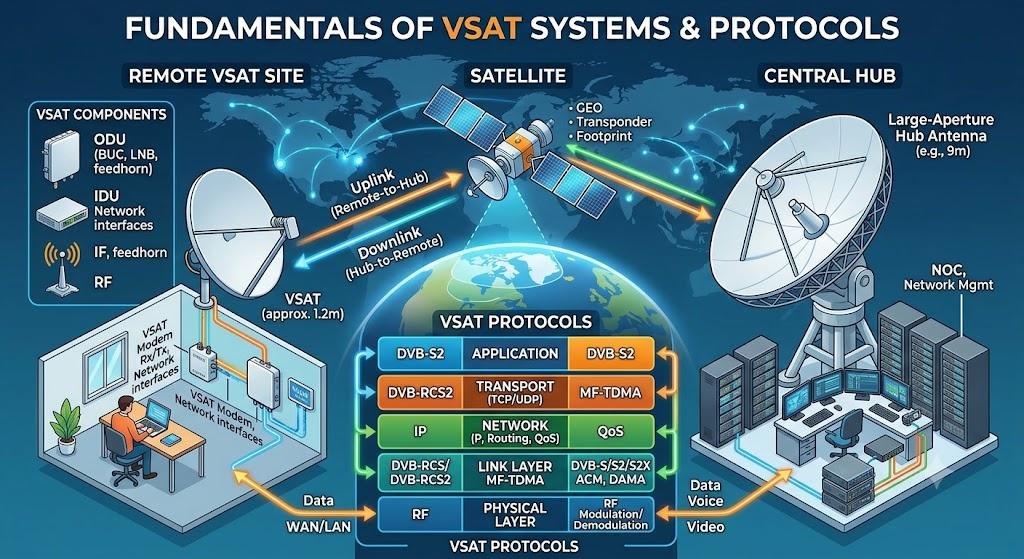
Anatomy of a VSAT System: Comprehensive breakdown of the ground segment (IDU, ODU, IFL) and space segment interactions.
Space-Ground Telemetry Mechanics: How satellites seamlessly manage duplex communications between centralized network operations centers (NOC), hubs, and remote VSAT terminals.
Day 2: VSAT Services and Features
Enterprise VSAT Network Topologies: Star, Mesh, and Hybrid network designs—selecting the right architecture for global business continuity.
VSAT Hardware & Subcomponent Ecosystem: Demystifying block upconverters (BUC), low-noise block downconverters (LNB), and satellite modems.
Multiple Access Methodologies: Deep dive into FDMA, TDMA, CDMA, and MF-TDMA protocols to maximize bandwidth efficiency.
Advanced Digital Modulation Techniques: Implementing BPSK, QPSK, 8PSK, and QAM within modern adaptive satellite networks.
Day 3: VSAT Propagation Aspects
RF and Microwave Frequency Band Allocations: Navigating C-band, Ku-band, and Ka-band characteristics, spectrum licensing, and operational rules.
Atmospheric & Environmental Propagation Effects: Quantifying and mitigating free-space path loss (FSPL), rain attenuation, atmospheric absorption, and polarization loss.
Centralized Earth Station Architecture: Designing robust satellite hubs, teleports, and large-aperture ground stations.
Remote VSAT Terminal Deployments: Engineering field-ready edge infrastructure and optimizing interfaces with local enterprise networks.
Day 4: VSAT Antennas & Polarization
Antenna Mechanics and Radiation Patterns: Principles of parabolic reflectors, gain profiles, beamwidths, and sidelobe suppression.
Precision VSAT Dish Pointing: Masterclass in azimuth, elevation, and polarization tilt calculations for instant signal locking.
Satellite Footprints & EIRP Mapping: Reading contour maps to match ground terminal dimensions with downlink signal strength.
Electromagnetic Wave Polarization: Implementing Linear (Vertical/Horizontal) and Circular (RHCP/LHCP) polarization to eliminate cross-polarization interference.
Day 5: VSAT Subsystems & Launching
Terminal Installation & Site Survey Blueprinting: Line-of-sight verification, structural mounting, lightning protection, and electrical grounding.
Commissioning & Hub Registration Protocols: Executing continuous-wave (CW) testing, cross-pol isolation verification, and satellite login.
Advanced Diagnostics & Troubleshooting: Mitigating uplink interference, localized hardware faults, coaxial cable defects, and bit error rate (BER) spikes.
Preventive Maintenance Frameworks: Proactive weatherproofing, structural calibration, and software updates to ensure 99.99% operational uptime.
Why Attend This Course?
| The Wins (What You Gain) | The Losses (What You Risk by Skipping) |
|---|---|
| Elite Engineering Expertise: Build a commanding, granular understanding of modern VSAT systems and advanced satellite tracking capabilities. | Technical Obsolescence: Remaining dependent on generic IT troubleshooting templates, completely unable to diagnose complex RF or satellite-specific link failures. |
| Next-Gen Tech Adaptability: Master the latest trends in LEO/MEO constellations, high-throughput satellite (HTS) routing, and advanced VSAT protocols. | Competitive Disadvantage: Falling behind as major telecommunication infrastructures rapidly transition toward dense, software-defined space architectures. |
| Optimized Network Performance: Learn to eliminate packet dropouts and latency issues by fine-tuning TCP/IP, VoIP, and video routing over satellite. | Suboptimal Deployments: Suffer from systemic latency, jitter, and dropped connections across your remote operations due to poor IP-over-satellite optimization. |
| Flawless Remote Resiliency: Deliver bulletproof satellite broadband, corporate VPN access, and critical communication channels to the most remote corners of the globe. | Costly Business Downtime: Risk catastrophic operational failure and severe link dropouts due to miscalculated rain fade margins or misaligned dish structures. |
| Accelerated Career Trajectory: Establish yourself as an authoritative, tier-one satellite communications specialist capable of winning premium enterprise contracts. | Career Stagnation: Getting trapped in entry-level, superficial network configuration roles while missing high-stakes aerospace and enterprise rollout opportunities. |
Conclusion
Mastering the fundamentals of VSAT systems, precise structural engineering, and modern satellite protocols is the ultimate master key to unlocking global data mobility, secure corporate communications, and true technical resilience. As the global telecommunications matrix migrates at an accelerated pace toward dense orbital networks and software-defined terminals, organizations can no longer afford to treat satellite communications as a standard IT add-on.
The Fundamentals of VSAT Systems & Protocols training course moves past surface-level definitions to equip you with rigorous, battle-tested engineering methodologies. Whether your goal is to manage massive corporate VSAT hubs, eliminate frustrating data packet issues over remote links, or confidently roll out multi-site satellite networks, this program delivers the exact structural tools required to execute without a single flaw. Secure your registration with ByB Training Company today, protect your global technical infrastructure, and transform complex orbital telemetry into predictable corporate growth.
Upcoming sessions
| City | Country | Date & time | Price | |
|---|---|---|---|---|
| Istanbul | Turkey | To be announced | 4,900.00 | Register now |
| Amman | Jordan | To be announced | 4,900.00 | Register now |
| Dubai | UAE | To be announced | 4,900.00 | Register now |
| Kuala Lumpur | Malaysia | To be announced | 4,900.00 | Register now |
| Cairo | Egypt | To be announced | 4,900.00 | Register now |
| Casablanca | Morocco | To be announced | 4,900.00 | Register now |
| Cape Town | South Africa | To be announced | 4,900.00 | Register now |
| Amsterdam | Netherlands | To be announced | 5,900.00 | Register now |
| Barcelona | Spain | To be announced | 5,900.00 | Register now |
| Paris | France | To be announced | 5,900.00 | Register now |
| Madrid | Spain | To be announced | 5,900.00 | Register now |
| Rome | Italy | To be announced | 5,900.00 | Register now |
| London | UK | To be announced | 6,100.00 | Register now |